A conference is judged before it begins — by the first page its speakers and authors ever see.
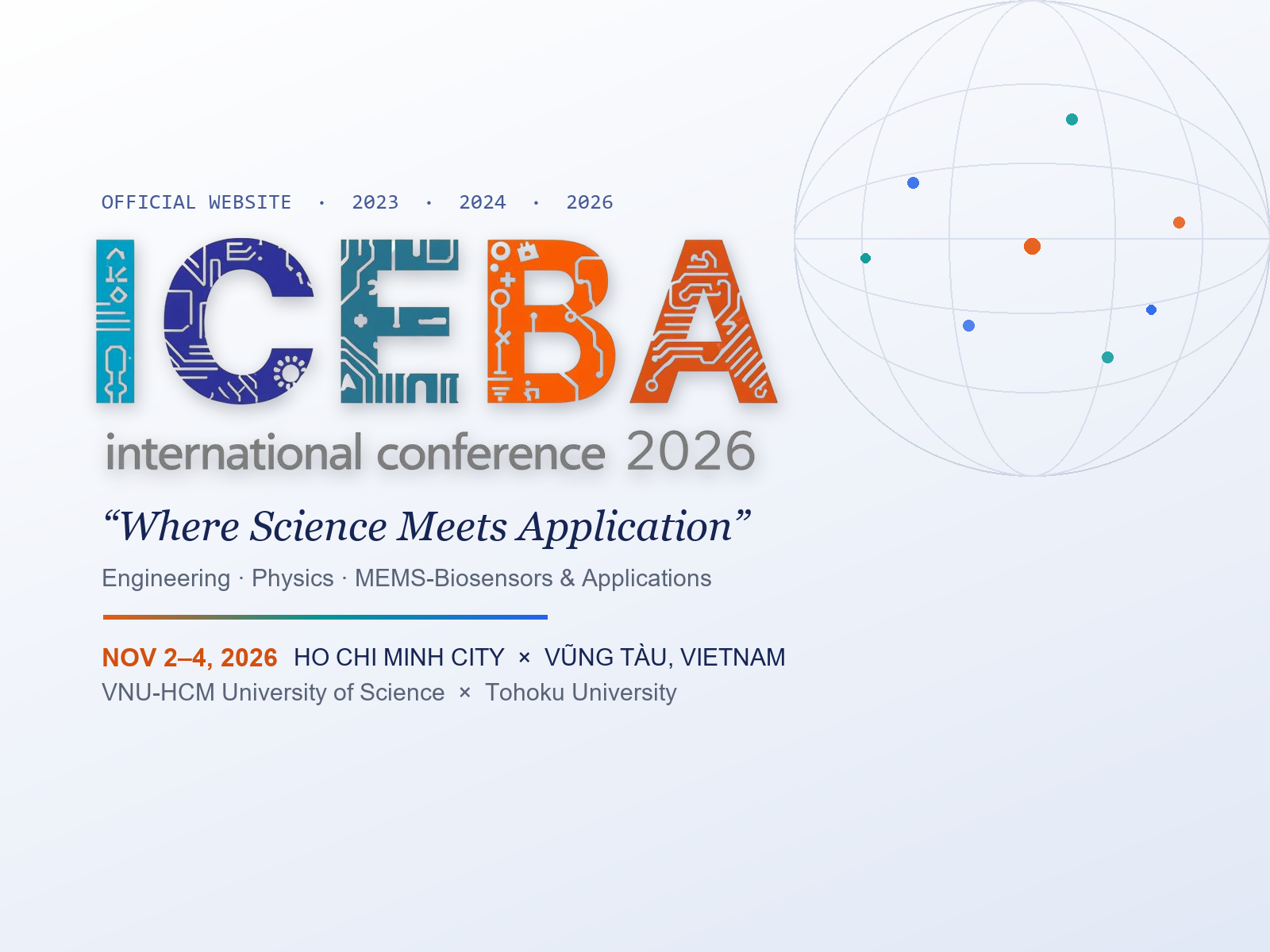
Before a single keynote is delivered, an international conference lives or dies on its website: it is where authors decide whether to submit, where speakers gauge how serious the event is, and where hundreds of attendees find dates, venues, and deadlines. I have been the web developer for ICEBA across three editions — 2023, 2024, and 2026 — the International Conference on Engineering, Physics, MEMS-Biosensors and Applications, hosted by VNU-HCM University of Science together with Tohoku University.
What the site carries
- →Program & tracks — thirteen technical tracks spanning applied physics, semiconductors, biomedical engineering, and IoT/AI.
- →Call for papers — submission and deadlines wired to Microsoft CMT for peer review, with Springer Nature (Scopus-indexed) proceedings.
- →Speakers, venue & travel — keynotes, the hybrid Ho Chi Minh City–Vũng Tàu venues, and the practical details attendees actually need.
Designed for a global audience
The conference runs November 2–4, 2026 under the theme “Where Science Meets Application,” drawing 150+ experts from academia and industry. The site has to earn trust at a glance from a reader who may be visiting from Tokyo, Singapore, or Berlin — so it is fast, responsive on every screen, and kept accurate as dates and speakers firm up.
An academic website has one job: to make a serious event feel exactly as serious as it is.